Two numbers came out of the same market report this spring, and if you only read one of them, you'd walk away with the wrong idea about Lake Gaston.
The first number: waterfront homes sold in the first three months of 2026 for an average of $913,881, down 19.47 percent from the same period in 2025. The median sale price dropped from $990,000 to $860,000 over that same stretch. Read in isolation, that looks like a lake in retreat.
The second number, from the exact same quarter: total unit sales across homes and land were up 17.11 percent year over year. More transactions closed, not fewer. A market that's actually shrinking doesn't produce more deals. Something else is going on, and it matters a great deal if you're comparing Lake Gaston against another second-home market and trying to figure out what the price tag on a listing is actually telling you.
Two Numbers From the Same Report
Prices falling and volume rising at the same time isn't a contradiction once you know what's driving each number. It's a sign that the market is sorting itself into two piles: homes priced for today's buyer, and homes still priced for 2021's buyer.
The second half of that story shows up clearly in the full-year 2025 data. Days on market for waterfront homes rose 44 percent over 2024, on top of a 50 percent increase the year before that. Two years running, homes have taken meaningfully longer to sell. At the same time, the average selling price actually crept up across all of 2025, closing the year at $959,087 per waterfront home, an increase over 2024's $871,716. So the full-year average went up while the first-quarter 2026 average went down, and days on market went up in both years.
That's not a market falling apart. That's a market where sellers who priced correctly kept selling at healthy numbers all through 2025, while a growing pool of overpriced listings sat unsold, dragging out the average time to close. When enough of those overpriced homes finally cut their prices or came off the books in early 2026, the reported average for that quarter dropped, not because buyers paid less for the same house, but because a different mix of houses closed.
Why the Average Can Fall While the Market Doesn't
There's a useful distinction hiding inside every one of these reports: the price a seller lists at and the price a buyer actually pays are two different data points, and the gap between them tells you more than either number alone.
In 2024, waterfront homes at Lake Gaston sold for 98.24 percent of asking price on average. In 2025, that ratio slipped to 96.15 percent. That's a small move on paper, roughly two percentage points, but on a $900,000 home it represents real negotiating room that simply didn't exist two years ago. Sellers are getting closer to what buyers are willing to pay, not because demand collapsed, but because the buyers who are active right now have more information, more patience, and more comparable sales to point to during negotiations.
A property's list price reflects what an owner hopes it's worth. Its sale price reflects what somebody actually paid for it. When those two numbers keep drifting apart, the honest reading is that pricing has been out of step with the buyer pool, not that the buyer pool has disappeared.
Here's how the last two full years and the most recent quarter line up against each other:
| Metric | 2024 (full year) | 2025 (full year) | Q1 2026 (vs. Q1 2025) |
|---|---|---|---|
| Average waterfront sale price | $871,716 | $959,087 | $913,881, down 19.47% |
| Median waterfront sale price | not separately reported | $832,500, up 4.91% | $860,000, down from $990,000 |
| Days on market, waterfront homes | up 50% over 2023 | up 44% over 2024 | not yet reported |
| Total transactions, homes and land | 431 | 435 | up 17.11% year over year |
Figures come from Roanoke Valley Lake Gaston Board of REALTORS® MLS reporting for the respective periods and reflect closed transactions only, not private sales.
Read across the row for total transactions and the picture sharpens. Volume barely moved from 2024 to 2025, then jumped noticeably in the first quarter of 2026. That's consistent with a backlog of overpriced 2025 listings finally clearing, at prices closer to what the market will actually bear.
The Buyer Pool Rewrote the Comparison
Part of why any single year's average is hard to compare to the last is that the pool of people buying at Lake Gaston has changed shape since 2020, not just the prices they're paying.
In 2020, nine waterfront homes at Lake Gaston sold for $1 million or more, and the priciest of them closed at $1.95 million. By 2025, that number had climbed to sixty homes over $1 million, with the top sale reaching $3.4 million. That's not a market that quietly appreciated year over year. That's a shift in who's buying: a larger share of purchasers now arriving with the budget and expectations of a luxury second-home buyer rather than a traditional lake-house family.
That matters for anyone trying to use a 2020 or 2021 sale as a comp for a 2026 purchase. The mix of homes changing hands has moved upmarket enough that year-over-year percentage comparisons can obscure more than they reveal unless you're also accounting for what's actually selling in that price tier now versus five years ago.
One Lake, Four Quads, Two States
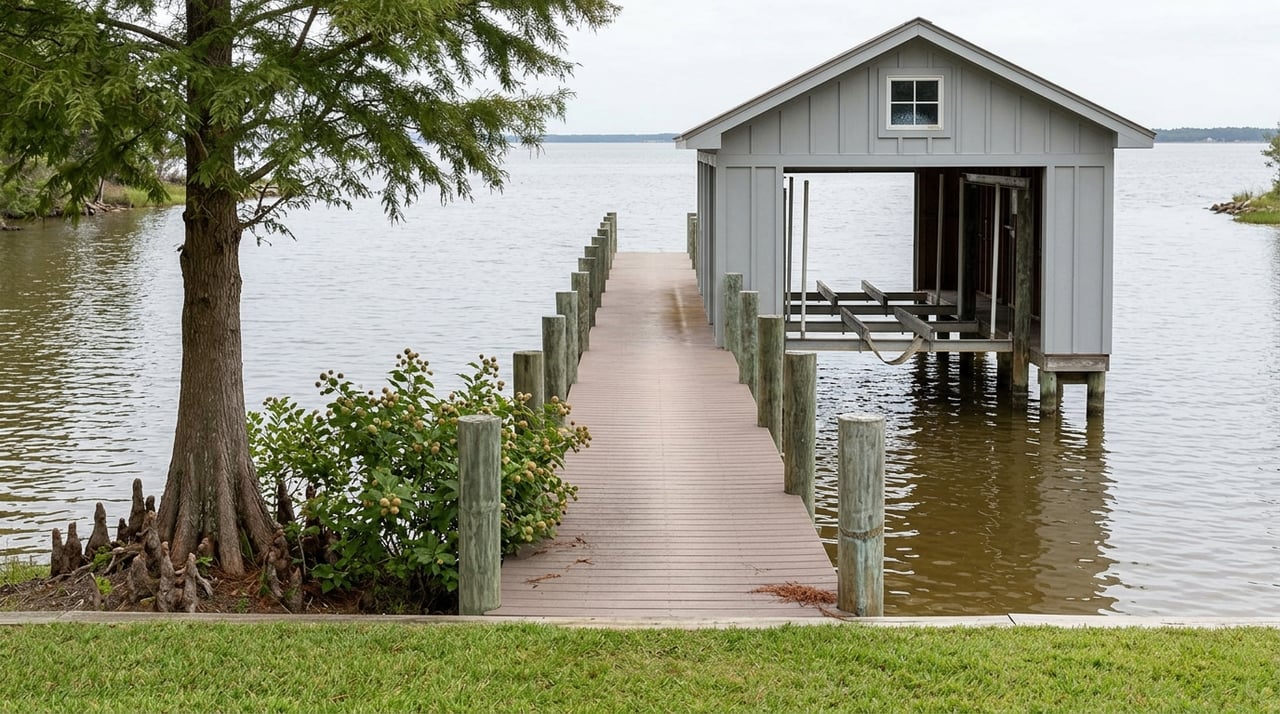
Part of what makes any single "Lake Gaston average" slippery is that Lake Gaston isn't one market. It's a 20,000-acre lake with 350 miles of shoreline, stretching across five counties in two states: Halifax, Warren, and Northampton counties in North Carolina, and Brunswick and Mecklenburg counties in Virginia. Locally, the lake is generally split into four quadrants, northeast, northwest, southeast, and southwest, with the Eaton Ferry Bridge marking the dividing point between them.
A blended average across all of that geography can mask real differences in what's actually selling in any given stretch of shoreline in a given quarter. If a disproportionate number of higher-end main-lake sales close in one quad during one quarter, and a cluster of smaller cove or offshore properties close the next, the lake-wide average will shift even if no individual property's value changed at all. That's one more reason the quarter-to-quarter average needs company data to be read correctly rather than taken at face value.
For a buyer comparing Lake Gaston to somewhere closer to Raleigh, the practical takeaway is to ask which quad, and which side of the state line, a listing sits in before treating any single average as representative. Waterfront property near the Eaton Ferry Bridge behaves differently than a cove property on the Virginia side, and both get folded into the same lake-wide number in every report.
What This Means If You're Comparing Neighborhoods
If you're weighing Lake Gaston against another lake or coastal market and you've only seen the topline price drop, here's the corrected version worth carrying into that comparison. Demand at Lake Gaston hasn't softened. What's changed is that sellers who priced against 2021 and 2022 expectations are finally being forced to meet the current buyer, and the properties doing that are still selling, often quickly, while the ones that haven't adjusted are the ones inflating the days-on-market figures.
For a buyer, that means the smartest move isn't waiting for the whole lake to get cheaper. It's identifying which listings have already adjusted to reality and moving on them, since correctly priced waterfront homes aren't sitting long even in this slower-moving stretch of the market. For a seller, it means the 96.15 percent sale-to-list ratio from 2025 is a more honest starting point for pricing than last year's asking price on the house down the street.
A Few Questions Worth Asking Before You Read the Next Report
Does a falling average mean waterfront values are actually dropping? Not necessarily. A falling quarterly average can reflect a shift in which homes closed rather than a drop in what any individual home is worth. The more reliable signal is watching sale-to-list ratio and days on market together over a full year, not a single quarter's average against last year's.
Is now a better time to buy or to sell at Lake Gaston? The data points to a market rewarding accurate pricing on both sides. Buyers have more negotiating room than they did in 2024. Sellers who price against current comparable sales, not against 2021 highs, are still closing at strong numbers and often faster than the headline days-on-market figure suggests.
If you're trying to make sense of what a specific listing's price actually means, or you're weighing Lake Gaston against a Raleigh-area neighborhood or the coast, that's exactly the kind of comparison Lake to Coast Real Estate works through with clients directly, quad by quad and comp by comp. Schedule a consultation with Neal Anderson to talk through what a specific number in a specific part of the lake actually means for your search.